
Skip to footer

INSIGHTS FOR HR AND WORKFORCE LEADERS

Business English is becoming a strategic workforce capability

Discover how HR and workforce leaders can assess, compare and develop workplace English communication skills to support global business performance.

Corporate
{"theme":"toeic-xlight","title":"English communication is workplace communication","headingTag":"h2","columns":"3","showSeparator":false,"enableAnimation":false,"enableSlider":false,"contentAlignment":"center","footnote":"\u003cp\u003e*Source: TOEIC® Global English Skills Report\u003c/p\u003e\r\n","infoCards":[{"image":"/content/dam/ets-org/brands/toeic/workplace-skill-image-1.png","imagetext":"Workplace skill image 1","headingTag":"h2","counter":"90","cardDescription":"\u003cp\u003eof employers say English proficiency is critical to organizational success\u003c/p\u003e\r\n"},{"image":"/content/dam/ets-org/brands/toeic/workplace-skill-image-2.png","imagetext":"Workplace skill image 2","headingTag":"h2","counter":"92","cardDescription":"\u003cp\u003esay English proficiency is more important today than it was five years ago\u003c/p\u003e\r\n"},{"image":"/content/dam/ets-org/brands/toeic/workplace-skill-image-3.png","imagetext":"Workplace skill image 3","headingTag":"h2","counter":"81","cardDescription":"\u003cp\u003esay AI is increasing the need for workplace English proficiency\u003c/p\u003e\r\n"}],"dataLayer":{},"formConfiguration":{"enableGatedContent":false},"formMessage":{}}
{"theme":"toeic-xlight","enableAnimation":false,"columnDistribution":"1:1","Cards":[{"line":false,"lineColor":"yellow","title":"Why is business English a priority for HR leaders?","description":"\u003cp\u003eHR and workforce leaders are under pressure to screen, hire, promote and develop talent in an increasingly global and digital environment, yet many lack visibility into their workforce’s business English skills.\u003c/p\u003e\r\n\u003cp\u003eWithout clear visibility into employee’s English communication skills and benchmarks for proficiency, organizations face:\u003c/p\u003e\r\n\u003cul\u003e\r\n\u003cli\u003eInconsistent hiring and promotion decisions\u0026nbsp;\u003c/li\u003e\r\n\u003cli\u003eLimited insight into workforce communication capabilities\u003c/li\u003e\r\n\u003cli\u003eMisaligned training investments with unclear outcomes\u003c/li\u003e\r\n\u003cli\u003eReduced efficiency across distributed, global teams\u003c/li\u003e\r\n\u003cli\u003eSlower execution in cross-border environments\u003c/li\u003e\r\n\u003c/ul\u003e\r\n","assetType":"image","imageUrl":"/content/dam/ets-org/brands/toeic/men-and-women.jpg","contentReverse":false,"formConfiguration":{},"formMessage":{}}],"dataLayer":{}}

What insights can benchmarking data provide for talent development?


HR and workforce leaders around the world are using workplace English benchmarks and measurement to support hiring, workforce development, global collaboration and business growth.


What is English communication benchmarking?

English communication benchmarking involves measuring and comparing English communication skills across roles, regions, business functions and career stages. It typically requires the use of standardized English assessments to ensure scores are stable and comparable over time.


HR use cases for English communication benchmarking

  • Create consistent communication standards across a global workforce
  • Make workforce decisions based on reliable data rather than assumptions
  • Ensure talent have role-aligned communication capabilities
  • Support collaboration and productivity in AI-enabled environmentsIdentify workforce readiness gaps before they impact performance

How talent management roles apply English communication benchmarking

For HR and talent leaders

Use English communication benchmarks to identify candidates with the skills needed to succeed in increasingly global roles.

For HR and talent leaders

Measure English communication skills to identify gaps and track progress over time.

For workforce planning leaders

Use English communication insights to align communication capabilities with workforce needs across regions, functions and business units.
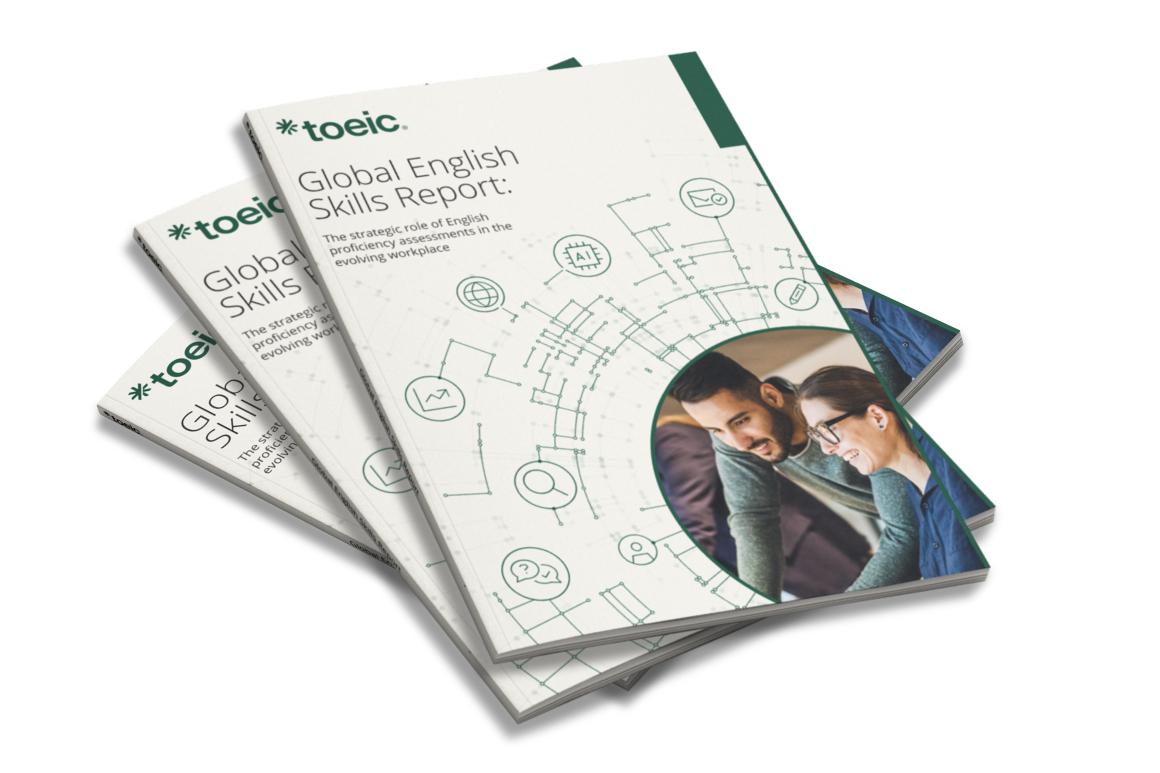


Global workforce communication insights

The TOEIC® Global English Skills Report highlights the trends shaping workplace English communication, from competitive advantage and AI readiness to measurement and development.

Based on input from 1,325 HR decision-makers across 17 countries, the report offers HR and workforce leaders a global perspective on workplace English communication skills and how English language assessments impact business performance.

The report helps answer key questions:

  • How do global workforce communication skills vary across regions and roles?
  • Where are the most significant English communication gaps?
  • How are organizations approaching English language assessment?


Skill report
{"id":"recirculation-module-1482795382","recirculationCardModuleTitle":"Key findings from the TOEIC Global English Skills Report","recirculationCardModuleTheme":"toeic-beige","numberOfColumns":"three","imageReverse":true,"disableSlider":false,"imageFullWidth":true,"ctas":[],"contactCtas":[{"ctaLabel":"Access the full Global English Skills Report","ctaLabelAccessible":"Access the full Global English Skills Report","ctaLink":"/toeic/resources/global-english-skills.html","ctaTarget":false,"ctaType":"secondary-cta","enableGatedContent":false,"ctaArrow":false,"enableIcon":false}],"recirculationCards":[{"recirculationCardTitle":"English skills are becoming a competitive differentiator","recirculationCardDescription":"\u003cp\u003e\u003cb\u003e86%\u003c/b\u003e\u0026nbsp;of employers say organizations without fluent English speakers are at a competitive disadvantage\u003c/p\u003e\r\n","recirculationCardVariation":"single"},{"recirculationCardTitle":"AI is amplifying the value of communication skills","recirculationCardDescription":"\u003cp\u003e\u003cb\u003eMore than 90%\u003c/b\u003e\u0026nbsp;of employers associate English proficiency with effective AI use, including prompt creation and evaluation of AI-generated content\u003c/p\u003e\r\n","recirculationCardVariation":"single"},{"recirculationCardTitle":"Organizations are investing in workforce readiness","recirculationCardDescription":"\u003cp\u003e\u003cb\u003e84%\u003c/b\u003e\u0026nbsp;expect organizations in their country to administer English assessments for new hires within five years\u003c/p\u003e\r\n","recirculationCardVariation":"single"}]}
{"theme":"toeic-white-green","headingTag":"h3","disableMultiClose":false,"title":"Workplace communication FAQs","searchEnable":false,"tableborder":true,"dataLayer":{},"questions":[{"title":"Why do organizations benchmark English proficiency?","accordionContent":"\u003cp\u003eBenchmarking English proficiency enables HR leaders to make fast, fair and defensible workforce decisions.\u003c/p\u003e\r\n\u003cp\u003eOrganizations that effectively benchmark and develop English proficiency are better positioned for global workforce collaboration, AI adoption and strategic workforce planning.\u003c/p\u003e\r\n"},{"title":"How can language benchmarking support workforce planning?","accordionContent":"\u003cp\u003eLanguage benchmarking gives organizations a clear, consistent view of English proficiency across roles, regions and career stages. This allows HR and workforce leaders to define role‑specific communication requirements, identify skill gaps and plan workforce capacity strategically.\u003c/p\u003e\r\n"},{"title":"Why is workplace English important for hiring and internal mobility?","accordionContent":"\u003cp\u003eWorkplace English is critical for effective communication, collaboration and relationship‑building in today’s global and digital environment. It enables employees to work across borders, engage with stakeholders and use tools such as AI effectively. By measuring English proficiency, employers can make fair, defensible hiring and promotion decisions, ensuring individuals are ready for the communication demands of their next role.\u003c/p\u003e\r\n"},{"title":"How can benchmarking support workforce development and promotion planning?","accordionContent":"\u003cp\u003eBenchmarking provides a data-driven foundation for employee development and career progression. By linking English proficiency scores to job requirements, organizations can identify development pathways, measure improvement over time and ensure promotion decisions are consistent and defensible. This helps align learning investments with business outcomes and supports continuous skill development.\u003c/p\u003e\r\n"},{"title":"How is English communication proficiency measured consistently across regions?","accordionContent":"\u003cp\u003eEnglish proficiency is measured consistently through standardized assessments like TOEIC, which provide stable, comparable scores across geographies and over time. This consistency enables organizations to evaluate talent fairly across global operations.\u003c/p\u003e\r\n"},{"title":"Why should companies use standardized English assessments?","accordionContent":"\u003cp\u003eStandardized English assessments give organizations trusted, objective data to support fast, fair and defensible workforce decisions. They reduce risk, align stakeholders and are correlated with better business outcomes.\u003c/p\u003e\r\n"}]}
{"infoCardModuleTitle":"Supporting workforce communication with research and insight","infoCardModuleDesc":"\u003cp\u003eThe TOEIC® program helps organizations understand, benchmark and develop business communication capabilities that support global collaboration, employee productivity and business performance.\u003c/p\u003e\r\n\u003cp\u003eExplore more research, insights and practical resources designed to help organizations prepare for a changing workforce.\u003c/p\u003e\r\n","infoCardModuleTheme":"toeic-xlight-green","columns":"4","enableDividers":false,"ctas":[],"infoCards":[{"infoCardLine":false,"infoCardTitle":"Why organizations trust TOEIC","cardNonClickable":false,"ctas":[{"ctaLabel":"Read now","ctaLink":"/content/ets-org/language-master/in/home/toeic/about/why.html","ctaTarget":true,"enableIcon":false,"enableGatedContent":false}]},{"infoCardLine":false,"infoCardTitle":"TOEIC blog","cardNonClickable":false,"ctas":[{"ctaLabel":"Read now","ctaLink":"/content/ets-org/language-master/in/home/toeic/about/blog.html","ctaTarget":true,"enableIcon":false,"enableGatedContent":false}]},{"infoCardLine":false,"infoCardTitle":"TOEIC test overview","cardNonClickable":false,"ctas":[{"ctaLabel":"Read now","ctaLink":"/content/ets-org/language-master/in/home/toeic/about.html","ctaTarget":true,"enableIcon":false,"enableGatedContent":false}]},{"infoCardLine":false,"infoCardTitle":"Corporate flyer","cardNonClickable":false,"ctas":[{"ctaLabel":"Read now","ctaLink":"/content/dam/ets-org/pdfs/toeic/toeic-gesr-corporate-flyer.pdf","ctaTarget":true,"enableIcon":false,"enableGatedContent":false}]}],"dataLayer":{},"formModals":[]}