Almost every week brings a new plan for preparing people for an economy shaped by artificial intelligence. The White House has called for a national effort to expand AI education. In February, the Department of Labor released an AI Literacy Framework declaring that “every worker will need baseline AI literacy skills to succeed, regardless of industry or occupation.” Employers surveyed by the World Economic Forum name analytical thinking as the core skill they want most, and one whose importance will only grow by 2030.
None of that is wrong. But most of these plans share an unstated assumption: that the foundation is already in place, and the job now is to build on top of it. A new issue brief from the ETS Center for Policy Research, Same Keys, New Doors: Foundational Skills and the Demands of a Changing World by Anita Sands and Cheryl Lavigne, tests that assumption against three decades of data. For a growing share of Americans, existing education and workforce systems have not provided or sustained that foundation.
What the data show
The brief draws on two of the best long-run measures we have: the OECD’s Survey of Adult Skills (PIAAC), which assesses adults aged 16 to 65, and the National Assessment of Educational Progress (NAEP), which assesses students at the end of high school. Read together, they tell a story that headlines about decline usually miss.
Among adults, the share reading at or below the lowest proficiency level rose from 19 percent in 1994 to 28 percent in 2023. Meanwhile, the share at or above Level 3, the threshold the OECD treats as necessary for full participation in an information-rich economy, fell from 54 percent to 44 percent. Between the 2013 and 2023 PIAAC cycles alone, literacy at the 10th percentile fell 36 points, while the top of the distribution barely moved.
Among students, the same divergence shows up before adulthood begins. The share of twelfth graders reading below NAEP Basic grew from 27 percent in 2005 to 32 percent in 2024. Scores at the 10th percentile fell 11 points; scores at the 90th were unchanged. The decline at the bottom was under way well before the pandemic.
Sands and Lavigne call this pattern skills divergence.
Why this matters for the AI conversation
Here is where the brief meets the trend I described at the start. PIAAC’s newest cycle added a measure of adaptive problem solving, which the OECD describes as the ability to reach a goal when conditions change and the first approach fails. It is the closest thing a large-scale assessment has to the “analytical thinking” employers say they want.
The brief shows how tightly that skill is tied to literacy. Among U.S. adults reading at Level 2, just below the key threshold, 9 percent reach the highest levels of adaptive problem solving. At Level 3, 56 percent do. At Levels 4 and 5, 95 percent do. In the assessment data, one proficiency level is associated with a sharp difference in the likelihood of demonstrating adaptive problem-solving skills.
Now look back at the Department of Labor’s framework. Its five areas of AI literacy include directing AI effectively, evaluating its outputs, and using it responsibly. Each of those is a reading and reasoning task. Judging whether a chatbot’s answer is right means holding a dense, possibly misleading text together and deciding which parts matter. That is very close to the OECD’s description of Level 3 literacy.
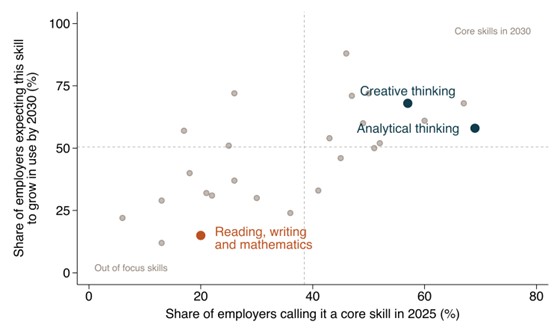
Share of employers calling each skill core in 2025, against the share expecting it to grow in use by 2030. Analytical and creative thinking sit in the upper right. Reading, writing and mathematics sit in the lower left.
Adapted from World Economic Forum, Future of Jobs Report 2025, Figure 3.6.
The World Economic Forum figure above makes the disconnect visible. Employers place analytical thinking among the core skills for 2030 and reading, writing and mathematics in the quadrant labeled out of focus. The skill they rank first runs through the skill they have stopped watching.
Doorstops, not gates
The brief’s most useful contribution may be its framing. Sands and Lavigne describe foundational skills not as a gate learners clear once, early in life, but as capacities that must be built and rebuilt across the life course. Their image for this is the doorstop. We must focus on the measures that open doors to opportunity and keep them from swinging shut.
That framing has practical consequences. Workforce programs typically treat literacy as a prerequisite, something to solidify before the valuable content begins. The evidence argues for the opposite design. If problem solving runs through literacy, then literacy belongs inside AI and upskilling programs, funded as part of them, rather than beside them. A well-designed course on directing and evaluating AI tools will not land the same way for an adult at Level 2 and an adult at Level 4, and the adults at Level 2 are the ones whose numbers are growing.
The brief closes with recommendations for policymakers, funders, K-12 educators, adult education and workforce practitioners, and researchers.
A series worth following
Same Keys, New Doors is the first issue brief in the Center for Policy Research’s Opening Doors series, which aims to say what education research can reliably tell us, surface connections that go unnoticed, and identify the doorstops that hold opportunity open. The first brief does exactly that. It takes a question everyone is asking, “How do we prepare people for an AI economy?” and shows that the answer starts a step earlier than most plans assume.
The next generation of jobs will ask people to work through problems that arrive with no procedure. Whether they can depends on something far less novel than the jobs themselves: The same keys, opening new doors.