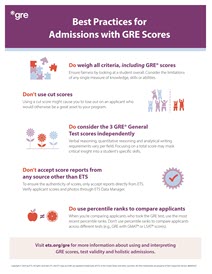
ETS provides interpretive data and resources for the GRE tests to assist graduate and professional schools, including business and law, in using scores for admissions purposes.

GRE® Guide to the Use of Scores
Provides information about the benefits of using GRE scores, the skills measured on GRE tests, scoring and score reporting, and using and interpreting GRE scores. Also includes the guidelines for the use of GRE scores, GRE test interpretive data, percentile rank information, reliability coefficients and standard errors of measurement.
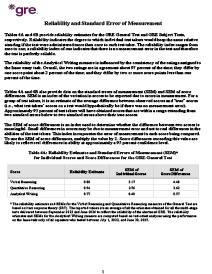
Includes reliability and standard error of measurement information to help score users understand what score differences between applicants are meaningful.
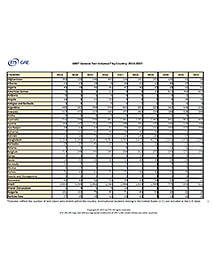
A Snapshot of the Individuals Who Took the GRE® General Test July 2018–June 2023
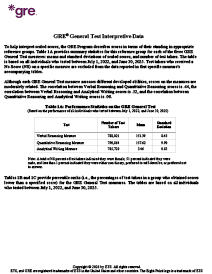
Provides characteristics of interest and performance information for test takers who took the GRE General Test. This report is intended to help GRE score users understand the scores they receive and to encourage appropriate score use.
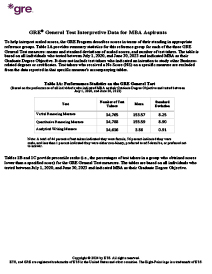
Provides summary statistics and percentile rank information for the Verbal Reasoning, Quantitative Reasoning and Analytical Writing measures based only on test takers who indicated they intended to pursue an MBA.
Contains fields of study from which test takers select their intended graduate major. Fields are grouped into graduate major fields (e.g., Biological and Biomedical Sciences and Chemistry) and broad graduate major fields (e.g., Life Sciences and Physical Sciences).
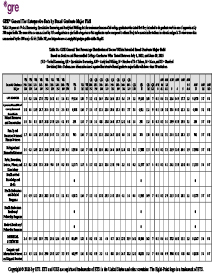
General Test Percentage Distribution of Scores Within Intended Broad Graduate Major Field
Contains Verbal Reasoning, Quantitative Reasoning, and Analytical Writing data for seniors and nonenrolled college graduates who stated that they intended to do graduate work in one of approximately 300 major fields. The score data are summarized into 51 broad graduate major field categories so that applicants can be compared to others likely to be most similar to them in educational goals.
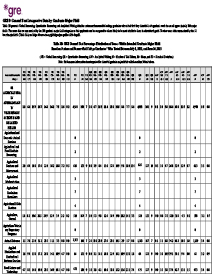
General Test Percentage Distribution of Scores Within Intended Graduate Major Field
Contains Verbal Reasoning, Quantitative Reasoning, and Analytical Writing data for seniors and nonenrolled college graduates who stated that they intended to do graduate work in one of approximately 300 major fields. The score data are summarized into 300 graduate major field categories so that applicants can be compared to others likely to be most similar to them in educational goals.
Statements that describe the overall quality of analytical writing, for each score level, demonstrated on the Issue and Argument tasks, along with the scoring guides for each task.
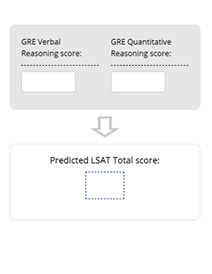
Allows users to calculate an applicant's predicted LSAT® score by entering GRE Verbal Reasoning and Quantitative Reasoning scores from the GRE General Test.
Presents analyses based on test takers who took the GRE General Test that show how adhering to a particular cut score policy can lead to systematically disregarding large numbers of candidates in various subgroups (e.g., race, ethnicity, gender).