Following the launch of the 2026 ETS Human Progress Report – 50 States Edition, an initial analysis of the individual state data has revealed a surprising trend around workforce disruption. For the first 15 states reviewed1, the workers responding best in terms of workforce readiness, aren't the ones with the least disruption — it’s those who have the resources to respond to it. This cuts against the usual narrative about disruption and fear.
More disruption, better preparation
The pattern is most clear when reviewing states at either ends of the disruption spectrum. Of the states reviewed to date, workers in New York report the highest rate of workplace disruption: 77% of workers say they've experienced a major workplace change in the past year, well above the 62% U.S. national average. Oklahoma workers sit at the opposite extreme, with only 52% reporting disruption.
If disruption bred anxiety, Oklahoma's workers should feel the most secure and New York's the most rattled. The opposite is true. Only 44% of New York workers feel underprepared for the next generation of jobs — the lowest rate of the initial 15-state cohort. In Oklahoma, that number is 66%, the highest of the cohort.
This isn't a fluke. Across all 15 states, there is a clear correlation between experience of disruption and feeling better prepared for the next generation of jobs. Workers in Kentucky report the second-lowest disruption rate of the cohort (54%), yet 59% feel underprepared for the next generation of jobs.
At the higher end of the disruption scale, 65% of workers in Louisiana and 66% of workers in North Carolina report experiencing disruption in the last 12 months, yet the percentage of workers feeling underprepared falls to 55% and 52% respectively. The trend line runs almost the entire length of the dataset: as disruption climbs, underpreparedness falls, step by step, state by state.
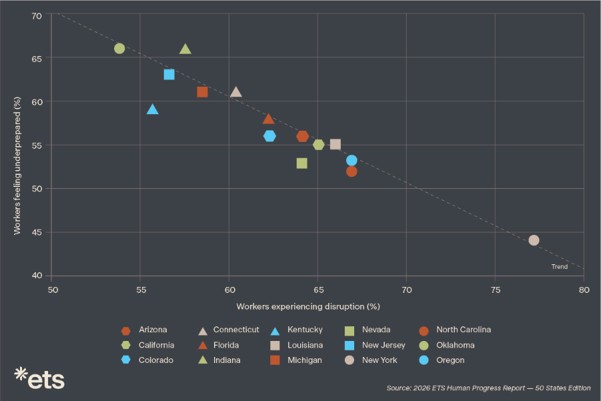
Graph to show the relationship between the percentage of workers experiencing disruption in the last 12 months and the percentage feeling underprepared for the next generation of jobs.
Proactive upskilling: the hidden connection
What explains the relationship between disruption and feelings of preparedness? Proactive upskilling. For workers in New York, their experience of disruption is matched by a proactive-upskilling rate of 79%. Disruption and proactive upskilling move together across the 15 states studied. Where disruption shows up, so does action. It's the action that seems to determine whether people feel ready for the next generation of jobs.
Workers in Oregon report a similar story on a smaller scale: 66% disruption, but 79% proactive upskilling and only 53% feeling underprepared. Nevada workers repeat the pattern a step down the curve — 63% disruption paired with 76% proactive upskilling. Workers in Nevada have one of the strongest upskilling rates reported in the 15-state cohort, and they experience a correspondingly low rate of underpreparedness (53%). Disruption clearly isn't destabilizing on its own. What destabilizes people is disruption without the conditions to upskill.
Consider the states where disruption and action are mismatched: workers in Oklahoma and New Jersey both report lower rates of disruption (52% and 55%) and relatively modest proactive-upskilling rates (66% each) — and in both states workers report higher rates of underpreparedness (66% and 63%). Workers in Kentucky offer the clearest case, reporting the second-lowest proactive-upskilling rate in the 15-state cohort at 60%, paired with one of the higher underprepared rates (59%).
Low exposure to change hasn't translated into a sense of security in any of these states. If anything, it's left workers less primed to act, and more anxious about a future they haven't started preparing for.
FOBO is a separate experience
If disruption doesn't predict feeling unprepared, it's worth asking whether it predicts a related but distinct fear: fear of becoming obsolete (FOBO). So far, there’s little evidence of a relationship between these two factors in the state-level data.
Fifty-seven percent of Michigan workers report disruption, a mid-level rate, yet workers in this state report the lowest obsolescence worry of the 15-state cohort at 46%. Meanwhile workers in Connecticut and North Carolina report moderate-to-high disruption levels (59% and 66%) — and workers in both states report obsolescence worry above 60%, among the highest in the dataset.
The lack of trend is revealing. It suggests "feeling ready for the future" and "fearing you'll become obsolete" are not the same emotional experience, even though they're often grouped together in conversations about the future of work. Preparedness looks like it responds to concrete action: upskilling, exposure, practice. Obsolescence anxiety looks more like a background hum that doesn't move much no matter how much change a state's workers have actually lived through.
Takeaways for employers and policymakers
Disruption may be unavoidable, but the data suggests it isn't the enemy. In fact, the states experiencing the most disruption are often faring the best on measures of preparedness. The real dividing line is whether disruption is met with action. States and companies serious about workforce readiness should treat proactive upskilling as an absolute priority, as it could be the deciding factor in whether workers feel ready for change, now and in future.
For more U.S. workforce trends, read the 2026 ETS Human Progress Report – 50 States Edition.
1. Arizona, California, Colorado, Connecticut, Florida, Indiana, Kentucky, Louisiana, Michigan, Nevada, New Jersey, New York, North Carolina, Oklahoma and Oregon.